Anthony Vaccarello Exits Saint Laurent: What Happens When a Designer Defines a Luxury House?
Anthony Vaccarello Exits Saint Laurent: The End of a Decade
Anthony Vaccarello is leaving Saint Laurent after a decade. GNG decodes his legacy, the power of a designer’s signature aesthetic and what comes next for the luxury fashion house.
Anthony Vaccarello, Saint Laurent creative director, Saint Laurent 2026, luxury fashion industry, fashion designer succession
A luxury fashion house is built on more than beautiful clothes. It is built on a point of view—a recognisable silhouette, a distinct attitude, a world that customers want to enter.
For the past decade, Anthony Vaccarello has helped define that world at Saint Laurent. Now, that chapter is coming to an end.
On 9 October 2026, Saint Laurent’s parent company, Kering, officially announced Vaccarello’s departure. The Belgian designer had led the French fashion house’s creative direction since 2016, helping strengthen its identity and cultural influence. The company has said that new creative leadership will be announced soon. [Source: Kering; Reuters]
The announcement raises a bigger question for the luxury industry: when a designer becomes inseparable from a brand’s identity, how does the house move forward without losing what made it desirable?
A Decade That Gave Saint Laurent a Distinctive Identity
When Vaccarello took over from Hedi Slimane in 2016, he inherited a fashion house with a powerful legacy and an established visual language.
His approach was not to erase that history. Instead, he developed it through a distinctly contemporary lens: sharp tailoring, strong shoulders, abbreviated silhouettes, sheer fabrics, dramatic black looks and a sensuality that felt both controlled and rebellious.
His Saint Laurent was recognisable without needing to explain itself.
That consistency became a defining part of the brand’s appeal. Across runway collections, advertising campaigns, celebrity dressing and accessories, the same attitude carried through: confident, provocative and unapologetically Parisian.
According to fashion coverage by Vogue, Saint Laurent’s annual revenue grew to approximately €3.3 billion by 2022 under Vaccarello’s leadership, illustrating the scale the house achieved during his tenure.
His legacy, therefore, is not simply a collection of memorable runway looks. It is a decade of translating a historic fashion identity into a contemporary luxury proposition.
The Power of a Designer’s Signature
The most influential creative directors do more than produce collections. They create a visual language that customers, stylists, celebrities and audiences can recognise almost instantly.
Think of the elements that make a fashion house distinctive:
- Silhouette: The shapes and proportions associated with its clothing.
- Colour and material: The recurring palette, textures and fabric choices that establish its mood.
- Styling codes: The way clothes, shoes, bags and accessories work together.
- Cultural associations: The celebrities, campaigns, films and public appearances that bring the brand’s identity to life.
- Emotional positioning: What wearing the brand communicates about the person wearing it.
Vaccarello brought these elements together into a consistent aesthetic. His Saint Laurent was not designed to appeal to everyone. Its identity depended on having a clear perspective.
That is an important distinction in luxury. Recognition creates familiarity, but a strong identity can also create desire. Customers are not necessarily buying only a jacket or a dress; they are buying into the attitude that surrounds it.
When the Creative Director Becomes Part of the Product
Luxury brands have always depended on the relationship between a founder’s vision and the house’s commercial life.
But the modern creative director occupies a complicated position. They are expected to protect heritage, generate new ideas, create media moments, attract customers and keep the brand culturally relevant—all at the same time.
A successful creative era can make a designer’s signature feel inseparable from the label itself.
This creates both an advantage and a challenge.
A recognisable aesthetic gives a brand continuity across seasons and markets. However, when customers strongly associate that aesthetic with one individual, a departure can create uncertainty about what the brand will look like next.
The transition is not simply about choosing another designer. It is about deciding which elements of the existing identity are essential, which can evolve and which new ideas the next creative leader should introduce.
The Business Question Behind the Creative Change
Vaccarello’s departure comes at a time when luxury fashion houses are navigating changing consumer demand and pressure to maintain growth.
Saint Laurent’s revenues declined in 2024 and 2025, according to Reuters, despite the brand’s earlier expansion. That context makes the next chapter particularly significant.
The incoming creative leadership will inherit a house with strong visual recognition, a global retail network and a well-established position in luxury fashion.
The challenge will be to preserve that recognition while continuing to create products customers want to buy.
Three questions will matter:
1. Can the brand evolve without abandoning its codes?
A dramatic departure from familiar silhouettes and styling could disrupt the consistency that customers recognise. Yet repeating the same formula indefinitely risks creative stagnation.
2. Where will the next chapter find growth?
New collections must work as both creative statements and commercial products. Womenswear, menswear, leather goods and regional demand will all be relevant to the house’s wider business strategy.
3. Can the brand maintain cultural relevance?
Runway shows, campaigns, celebrity relationships and visual storytelling contribute to a luxury house’s cultural visibility. The next creative leader will need to establish a perspective that feels distinctive rather than derivative.
These are industry questions, not predictions about the successor or the direction Saint Laurent will take.
The Final Show: A Fitting End to an Era
Vaccarello’s Spring/Summer 2027 show in Paris took on additional significance following the official announcement.
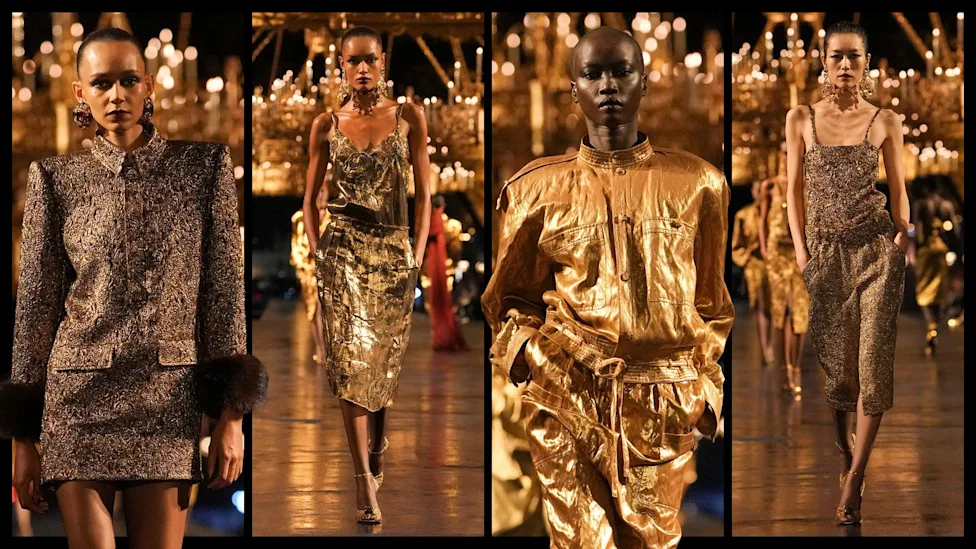
The collection’s dramatic gold-and-black palette connected the presentation to the house’s historic glamour while reflecting the visual codes associated with his tenure. The show was staged beneath the Eiffel Tower, a setting that has become closely associated with Saint Laurent’s large-scale Paris presentations.
What makes the moment significant is the way it brings together the two forces that define luxury fashion: heritage and reinvention.
The house’s identity belongs to a history that predates any one designer. Yet every creative director leaves a mark on how that history is interpreted for a new generation.
Vaccarello’s decade demonstrated how a designer can build a recognisable contemporary identity while working within the boundaries of an established fashion house.
What Other Luxury Brands Can Learn
Saint Laurent’s transition offers lessons beyond the runway.
Consistency is a commercial asset. A recognisable identity helps consumers understand what a brand stands for.
Heritage needs interpretation. Archival references matter most when they are made relevant to contemporary customers rather than repeated mechanically.
Creative leadership shapes more than products. Campaigns, celebrity dressing, retail experiences and cultural projects all contribute to how a luxury house is perceived.
Succession is part of brand strategy. A house must be able to outlive the individual who leads its creative direction. The strongest brands build an identity that can evolve without becoming unrecognisable.
For emerging Indian luxury labels, the lesson is especially relevant. International recognition requires more than a striking collection or a high-profile fashion week appearance. It requires distinctive design codes, a consistent point of view and a business capable of sustaining that identity over time.
The GNG Take
Anthony Vaccarello’s departure is more than a creative-director announcement. It is a reminder that the identity of a luxury house is one of its most valuable assets—and one of its most delicate.
A designer can transform a brand’s contemporary image, but the ultimate test is whether that identity remains meaningful beyond the person who created its latest chapter.
Saint Laurent now faces that test.
The question is not whether the next creative director will design differently. Change is inevitable. The more important question is whether the house can evolve while retaining the tension, confidence and recognisability that made Vaccarello’s era distinctive.
In luxury fashion, a designer may leave. The identity they build must be strong enough to stay.