Lakmé Fashion Week Is Back: The Indian Designers and Craft Stories to Watch in 2026
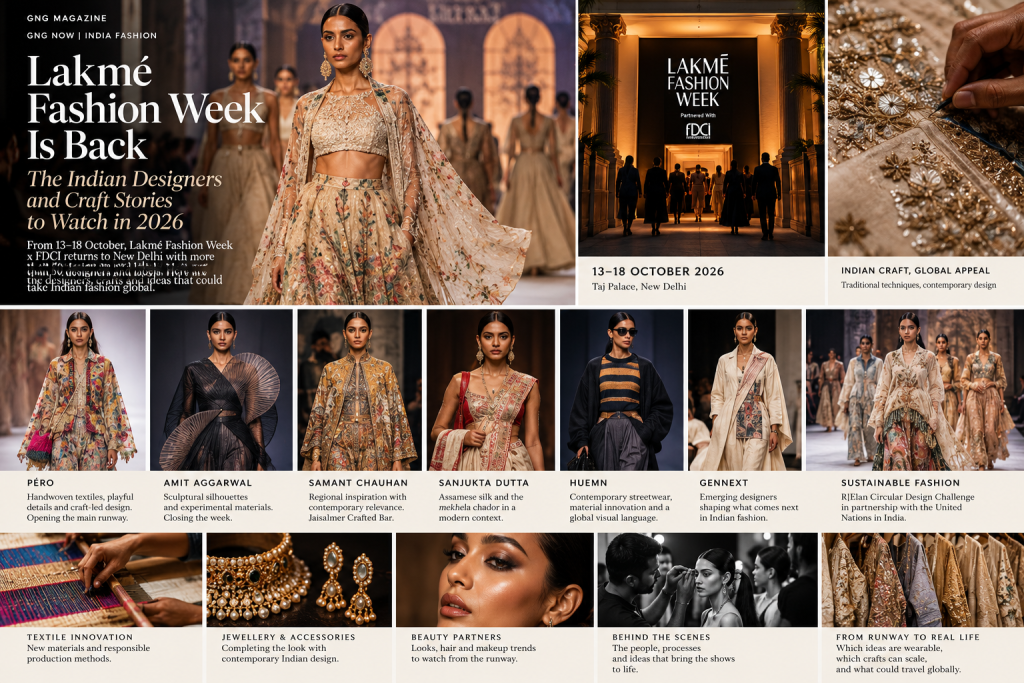
GNG NOW | INDIA FASHION | DESIGNER SPOTLIGHT
Lakmé Fashion Week 2026: Indian Designers and Trends to Watch
Lakmé Fashion Week x FDCI returns to Delhi from 13–18 October 2026. Discover the designers, Indian crafts, emerging talent and sustainable fashion ideas to watch.
Lakmé Fashion Week 2026, Lakmé Fashion Week Delhi, Indian fashion designers 2026, Indian craftsmanship, emerging Indian designers
Indian fashion is heading into one of its most important moments of the season.
From 13 to 18 October 2026, Lakmé Fashion Week, in partnership with the Fashion Design Council of India (FDCI), returns to New Delhi with more than 50 designers and labels, bringing established names, emerging talent and craft-led collections into the spotlight. The event comes just as the international fashion calendar turns its attention towards India and the country’s festive and wedding seasons approach. <Cite refs={[“turn271977search4″,”turn271977search3”]}/>
But the most interesting question is not simply what will appear on the runway.
Which Indian design ideas have the potential to resonate beyond the domestic market? Which traditional crafts are finding new relevance? And how are emerging designers translating Indian identity into a language that international audiences can understand?
For GNG, this edition is an opportunity to look beyond the front row and explore the ideas, techniques and creative businesses shaping the next chapter of Indian fashion.
1. The Week Opens With a Question About Fashion’s Future
The programme begins on 13 October with the finale of the R|Elan Circular Design Challenge, in partnership with the United Nations in India. The main runway schedule at the Taj Palace, New Delhi, follows from 14 October. <Cite refs={[“turn271977search3″,”turn271977search2”]}/>
The Circular Design Challenge puts sustainability and material innovation into the conversation before the traditional runway collections begin.
That matters because fashion’s environmental impact is not determined by appearance alone. The fibres, embellishments, production processes and lifespan of a garment all influence its footprint.
For Indian fashion, this creates an important opportunity: can the country’s existing strengths in textile knowledge, repair, handwork and material reuse contribute to more responsible contemporary design?
The challenge is to move beyond sustainability as a marketing phrase and examine what designers are actually changing in their materials and production methods.
The GNG lens: Watch for specific innovations that can be explained clearly—new materials, reduced waste, reuse of existing textiles or production methods designed to extend a garment’s life.
2. Péro: Why Craft Can Be a Contemporary Design Language
The main runway programme opens on 14 October with Péro, the label founded by Delhi-based designer Aneeth Arora. <Cite refs={[“turn271977search3″,”turn271977search6”]}/>
Péro is known for its playful approach to handwoven textiles, intricate details and craft-led design. Rather than treating traditional techniques as references to the past, the label builds them into contemporary clothing with a distinct visual identity.
This approach raises a larger question for Indian fashion: what makes craftsmanship relevant to a new generation of consumers?
It is not simply the presence of hand embroidery or handwoven fabric. It is the way those techniques are incorporated into silhouettes, styling and a recognisable design language.
A craft becomes more visible to an international audience when it is accompanied by a clear story about its origin, the people who make it and the purpose it serves in the finished garment.
What GNG will be watching: How designers communicate the value of handwork, and whether craft-led collections offer new ideas for everyday dressing rather than only ceremonial occasions.
3. GenNext: The Designers Who Could Shape What Comes Next
Established designers often dominate fashion-week headlines, but emerging talent can offer a different view of where Indian fashion is heading.
The GenNext programme is one of Lakmé Fashion Week’s platforms for introducing newer designers to the industry. Its importance lies in creating visibility for labels that are still developing their signature aesthetic, commercial model and audience. <Cite refs={[“turn271977search0″,”turn271977search6”]}/>
For these designers, the runway is only the beginning. Building a sustainable fashion business requires more than a compelling collection.
Designers need to establish a recognisable identity, understand production costs, develop relationships with buyers and communicate why their work deserves a place in a crowded market.
The most interesting emerging labels may not necessarily be the ones with the most elaborate presentations. They may be the ones that demonstrate a clear point of view and the ability to translate it into products customers want to wear.
The GNG lens: Look for distinctive silhouettes, unexpected textile combinations, contemporary interpretations of Indian craft and ideas that could translate into a long-term brand rather than a single memorable runway moment.
4. Samant Chauhan and the Power of Place
Samant Chauhan is among the established designers featured in the Delhi schedule, with a collection presented under the title Jaisalmer Crafted Bar. <Cite refs={[“turn271977search0”]}/>
The reference to Jaisalmer brings attention to the role of place in fashion storytelling.
India’s regions hold different textile traditions, techniques, materials, colour palettes and craft histories. When these influences are translated thoughtfully into contemporary design, they can give a collection a sense of identity that goes beyond seasonal trends.
But regional inspiration works best when it is more than a visual theme. The deeper story lies in the materials, techniques, artisans and cultural knowledge behind the finished garment.
For designers looking to reach international markets, this can be a meaningful point of difference—provided the story is specific, accurate and respectful of its origins.
What GNG will be watching: How regional references are translated into contemporary silhouettes, and whether the craft narrative is supported by clear information about the techniques and makers involved.
5. Sanjukta Dutta: Bringing Regional Textiles Into Contemporary Fashion
Assamese silk and the mekhela chador offer a powerful example of how regional textiles can be presented through a contemporary fashion lens.
Sanjukta Dutta, an Assam-based designer known for her work with Assamese dress and silk traditions, is listed in the 16 October programme. <Cite refs={[“turn271977search0”]}/>
The opportunity here extends beyond occasionwear. Regional textiles can introduce different textures, weaving traditions and forms of draping into modern wardrobes.
The challenge is to preserve the integrity of the craft while making the finished pieces relevant to contemporary customers—whether through styling, proportion, versatility or new ways of wearing traditional garments.
For Indian designers, this is also a reminder that global appeal does not necessarily require abandoning regional identity.
The GNG lens: Explore how designers can make regional craft visible to new audiences without reducing it to a decorative motif.
6. HUEMN: Where Indian Fashion Meets a Global Visual Language
HUEMN, founded by Pranav Misra and Shyma Shetty, is among the labels scheduled to present a collaboration with R|Elan during the week. <Cite refs={[“turn271977search0”]}/>
The label’s contemporary streetwear approach provides a useful counterpoint to the embroidery-heavy and ceremonial looks often associated with Indian fashion coverage.
It demonstrates why Indian fashion should not be understood through a single aesthetic. The country’s design landscape includes heritage textiles, couture, experimental construction, streetwear and contemporary ready-to-wear.
The international opportunity lies partly in this diversity. Designers can draw from their own cultural contexts while working with silhouettes, styling and visual communication that resonate with different markets.
The question is not whether Indian fashion should look traditional or Western. It is whether a designer can develop an original perspective that is recognisable, wearable and commercially sustainable.
What GNG will be watching: How material innovation, contemporary styling and a consistent brand identity work together in the collection.
7. The Italian Connection: A Conversation About Craft and Business
The programme also includes Eccellenza: The Artisans of Italian Style, an Italian craftsmanship showcase scheduled for 17 October. <Cite refs={[“turn271977search0”]}/>
Its presence creates an opportunity to look at craftsmanship as an international exchange rather than a story belonging to one country alone.
Italian fashion has built a global reputation around areas such as leatherworking, tailoring and specialist manufacturing. India has its own extensive textile, embroidery, weaving and artisanal traditions.
These are not identical industries, and their histories should not be simplified into a direct comparison. But they raise an interesting business question: how do craft traditions become visible, desirable and commercially valuable in international luxury markets?
The answer often involves more than the finished product. It includes specialist skills, quality control, distinctive design, reliable production and the ability to tell a credible story about how something is made.
The GNG lens: Treat the Italian showcase as an opportunity to examine the relationship between craftsmanship, manufacturing expertise and international luxury positioning—not simply as another runway event.
8. Amit Aggarwal: A Different Vision of Indian Couture
The week is scheduled to close on 18 October with AM.IT by Amit Aggarwal, presented by House of Lakmé. <Cite refs={[“turn271977search3″,”turn271977search6”]}/>
Aggarwal’s design language is associated with sculptural silhouettes, experimental materials and an architectural approach to couture.
His work is relevant to the broader conversation about how Indian designers can build distinctive visual identities. Craft and heritage are important parts of Indian fashion, but innovation can also come from material experimentation, construction and the reinterpretation of familiar forms.
A strong design identity does not need to fit into one established category. It can emerge from the relationship between technique, material and the designer’s own perspective.
What GNG will be watching: How experimental construction and a recognisable aesthetic are translated into the closing presentation, and how the collection connects with the designer’s wider brand identity.
What Should the International Fashion Industry Be Watching?
Rather than predicting a single dominant trend before the shows take place, GNG will be looking for five questions that can be answered through the collections and designer conversations.
1. Which Indian craft techniques are being reinterpreted?
Look beyond the presence of embroidery or handloom. Identify the specific technique, the region or community associated with it where verified, and how the designer has incorporated it into the collection.
2. Which emerging designers have a distinctive point of view?
A memorable collection can attract attention, but a consistent design language is more useful for building a lasting business.
3. Where is material innovation happening?
Examine fabric choices, construction, reuse and production methods. Separate demonstrable innovations from broad sustainability claims.
4. How is Indian occasionwear changing?
With the festive and wedding seasons approaching, look for changes in silhouettes, styling, versatility and the balance between traditional craftsmanship and contemporary dressing.
5. What makes a collection internationally relevant?
Consider originality, quality, wearability, cultural context and the ability to communicate the design story to audiences unfamiliar with its origins.
These questions will provide a more useful basis for post-show analysis than simply naming the most photographed looks.
The GNG Take
Lakmé Fashion Week is an opportunity to examine Indian fashion as both a creative industry and a growing collection of businesses with different ambitions.
Some designers are building on regional textile traditions. Others are experimenting with materials, developing contemporary streetwear or creating sculptural couture. Emerging labels are trying to establish their identities, while established names continue to interpret Indian fashion for changing audiences.
The important story is not that one approach will replace another.
It is that Indian fashion has multiple ways to express its identity—and each requires a different conversation about craftsmanship, originality, commercial viability and international relevance.
Over the coming week, GNG will look beyond the runway photographs to the ideas behind the collections: the designers, techniques, materials and creative decisions that make Indian fashion worth watching.
Because the next important Indian fashion story may not be the look everyone photographs. It may be the idea that changes how the industry designs, makes and sells fashion.
GNG NOW | India Fashion, decoded for a global audience.
Editorial note: This is a preview written ahead of the event. References to collections and designers are based on the published schedule; the article does not claim to have reviewed collections that have not yet been shown. Update the story with verified runway images, designer statements and collection details as the event unfolds.